

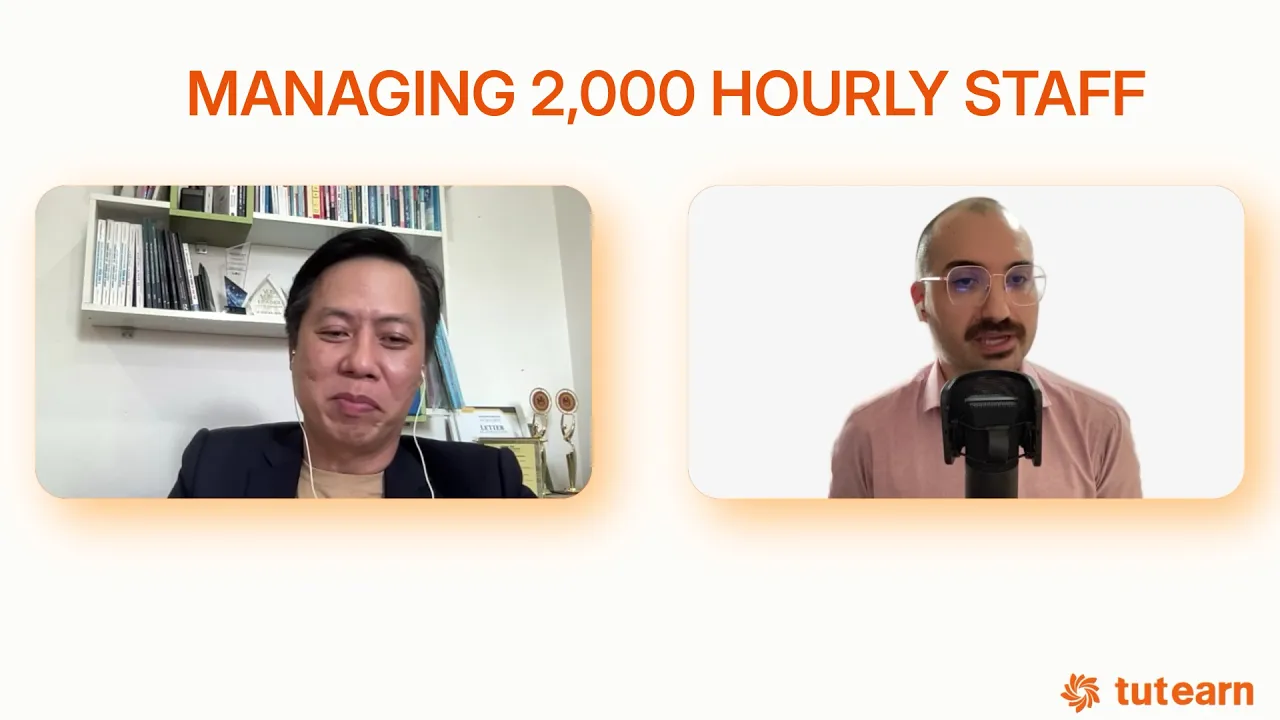
Managing High-Volume Teacher Operations in Vietnam with Le Quoc

Le Quoc
Voices of Change (VOC)
Discover how to optimize high-volume language center operations, automate complex hourly payroll, and boost part-time teacher retention in Southeast Asia.
Key Insights from Le Quoc
The Evolution of the Vietnamese English Center Market
The landscape of English language education in Vietnam shifted dramatically over the past two decades. Students transitioned from attending basic public school extra classes to pursuing international standardized certifications like IELTS and Cambridge early in their academic journeys. Post-pandemic dynamics accelerated tech integration, forcing centers to embed digital applications directly into traditional curricula. This shift changed the teacher's role from a primary knowledge transmitter to an operational guide within an information-abundant ecosystem.
Structural Strategies for Part-Time Teacher Retention
Scaling operations across 40 to 50 campuses requires structural retention mechanics that move beyond baseline financial compensation. High-volume centers must build dedicated operational support frameworks to stabilize part-time staff networks.
Localized Operational Leadership: Decentralizing campus management by placing one dedicated manager per location ensures immediate conflict resolution for staff and students, eliminating administrative gridlock.
Differentiated Non-Monetary Benefits: Providing critical expat infrastructure like comprehensive health insurance and housing assistance creates a strong competitive advantage that anchors foreign talent.
Rule-Based Payroll Automation: Replacing manual spreadsheet tracking with automated software linked directly to course outlines prevents costly calculation errors and protects center margins.
Navigating the Operational Friction of English Center vs. K-12 Models
Language centers face structural operational volatility that distinguishes them sharply from formal K-12 institutions. Understanding these specific friction points allows operators to secure their revenue pipelines against sudden churn:
Enrollment Compulsion Variance: K-12 students operate within a compulsory framework, remaining anchored for full academic years. English center students treat language acquisition as elective training, resulting in high cyclical churn where clients leave after a single three-month course and return unpredictably.
Staffing Commitment Disparities: K-12 institutions secure high-commitment, long-term talent because they recruit the industry's top tier into full-time contracts. English centers rely heavily on highly volatile part-time hourly networks, which limits voluntary participation in professional development workshops unless center owners deploy dedicated compliance structures.
Tracking and Cohort Complexity: The fluid nature of short-term language center enrollments demands robust tracking systems to monitor individual student academic records and lifecycles. Lacking adequate software creates major administrative leaks when students pause and resume their studies across different periods.
Amplifying the Educator's Voice Beyond the Classroom
Sustaining long-term industry growth requires empowering educators to monetize their proprietary expertise and intellectual property. True operational maturity occurs when centers provide accessible platforms for teachers to scale their pedagogical innovations globally without bureaucratic friction.
"We want teachers' voices to be heard beyond the classroom. Their ideas and creativity should be shared, and they should receive financial compensation back for their contributions."
Connect with Le Quoc
Website: Voices of Change Website
LinkedIn: Le Quoc on LinkedIn
Company LinkedIn: Voices of Change on LinkedIn
Facebook: Le Quoc on Facebook
Episode Timestamps
00:04 - Introduction to The Learning Curve and host Adam.
00:44 - Le Quoc introduces his 20-year education background in Vietnam.
01:26 - The structural shifts in Vietnamese classroom authority and post-COVID AI adoption.
02:24 - Transitioning from public school teaching to scaling private English centers.
03:49 - Managing operations and academic training across 40 to 50 campuses.
04:55 - The evolution of student goals and international standardized certifications in Vietnam.
06:37 - The operational reality of hourly, part-time foreign teacher management.
08:38 - Competitive strategies for attracting and retaining high-value part-time staff.
10:29 - The single most critical retention factor for modern tutoring centers.
11:40 - Restructuring management architecture: shifting to the single-campus manager model.
12:58 - Attracting expat talent using infrastructure incentives and comprehensive insurance.
14:19 - Key operational patterns and challenges observed across K-12 and language centers.
17:28 - The bottleneck of high-volume hourly teacher scheduling and payroll.
18:42 - Moving away from manual Excel formulas to automated school management platforms.
20:37 - Managing the structural churn and academic tracking of elective student bases.
21:55 - Technology adoption realities and implementation barriers for Southeast Asian center owners.
23:11 - The origin story of EdUverse and supporting remote educational communities.
26:18 - Introducing Voices of Change (VOC): a platform for educator intellectual property monetization.
29:07 - Details on the upcoming global launching event on July 7th.
30:54 - Closing remarks and where to connect with Le Quoc online.






"We used to spend 10–15 hours weekly on manual scheduling and payroll corrections. Now everything runs in one system — scheduling, payroll, and business report. Tutearn reduced admin work by over 60% even though we doubled our student base."
Zwe
CEO
Pace Forward Thailand